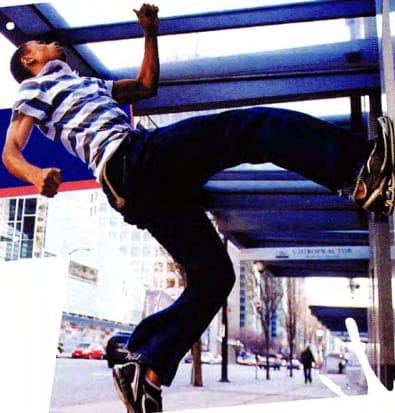
was developed in France in the 1980s by Raymond Belle and later by his son David Belle and his friends. It is based on military obstacle course training. The aim is to get from one point to another in any way you can, and express yourself while doing so. There are no limits on how you move in parkour: running, climbing, swinging, jumping, rolling and any other types of movement are possible. Parkour is more of a philosophy or set of ideas than a sport. It is a new way of seeing the environment and finding ways to go over, under, around, across or through obstacles.
can be done alone or in groups. The most famous group of traceurs (people who do parkour) were the Yamakasi, a group made up of David Belle and his friends and cousins. They formed in the late 1980s and became popular during the 1990s and 2000s after appearing in several films, documentaries and advertisements. In the Yamakasi, there were strict rules. Members had to arrive on time and they were not allowed to complain or make excuses. They valued humility, so they were not allowed to show off or compete with other members.
is a 'state of mind'. It is about getting over mental as well as physical barriers. It teaches people to touch the world and interact with it. It is about understanding what it means to be human. The organisation Parkour.net believes that parkour can never be a competitive sport. It is an art and is concerned with self-development. They say you can't ask, 'Who is the best at parkour?' Raymond Belle's advice is: 'If two roads open up before you, always take the more difficult one. Because you know you can travel the easy one.
are some gyms and camps where you can practise and learn parkour. However, many traceurs do not like the idea of special places for their activity. The idea behind parkour is to adapt to any environment and be creative about how you get through it. It is about freedom and self expression. The founder of parkour refused to teach people how to do moves or get over obstacles. The whole point is to learn your own technique and way of moving. So the idea of having classes or a limited space to practise in conflicts with the values of parkour.
is also known as free running. Sometimes free running refers to another form of parkour developed by Sebastien Foucan, which has more focus on the individual. The term free running came out of the filmJump London (2003). It told the story of three French traceurs practising parkour around the famous monuments of London. Free running was the English translation of parkour. There are more similarities than differences between the two activities, and the Parkour UK website uses the two terms to refer to the same activity.

Bình luận